Navigating the Rate Cut: A Guide for Advisors

Introduction

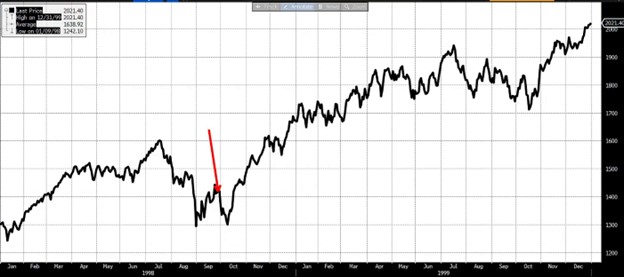
The ongoing Federal Reserve cycle has sparked intense debate regarding its resemblance to the 2007 and 1998 financial crises. While a definitive answer remains elusive, the devil is indeed in the details. The current economic landscape shares similarities with both 2007 and 1998, but the specific outcomes remain uncertain. The stark contrast between the record-breaking stock market of 1998 and the near-50% decline in 2007 underscores the importance of discerning the underlying factors driving each crisis. However, one consistent element across these periods is the rise in volatility following Federal Reserve rate cuts.

Source: Bloomberg

Historical Context and Current Trends

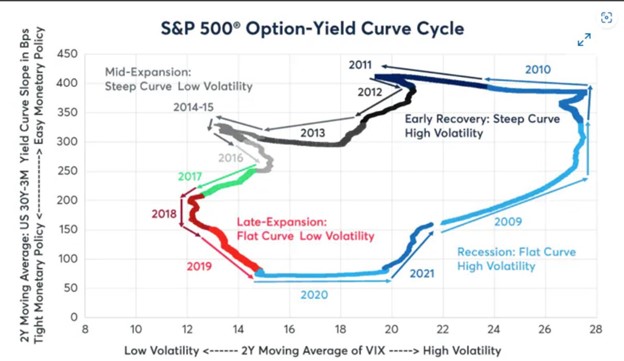
A recurring pattern emerges in financial markets: a steepening yield curve often coincides with increased volatility. This phenomenon is evident in both 2007 and 1998, as well as other periods of economic downturn.

Source: CME Group

  • The Volatility Cycle: The yield curve’s movements often correlate with cyclical volatility patterns. A flat yield curve, typically associated with the end of an economic expansion and higher interest rates, often precedes a period of lower volatility. When the Federal Reserve cuts rates, steepening the yield curve, volatility tends to rise. This peak in volatility often coincides with the steepest point of the yield curve.
  • The 2007 and 1998 Comparison: While both 2007 and 1998 featured a steepening yield curve and rising volatility, the underlying causes differed. In 1998, a volatility shock triggered by the Russian debt crisis prompted the Fed to lower rates. Conversely, in 2007, the Fed’s rate cuts were a response to a deteriorating labor market.


Volatility and the yield curve, often described as mean-reverting, exhibit a similar cyclical pattern of highs and lows.

The Current Landscape

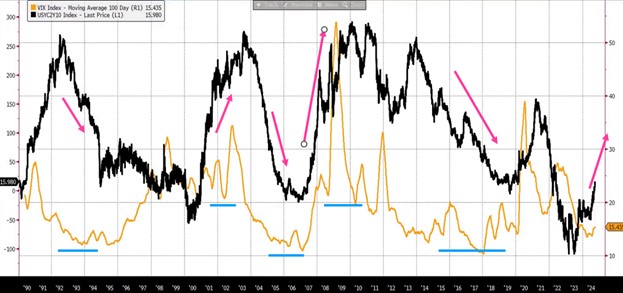
The Federal Reserve’s decision to lower interest rates in 2024, amidst a backdrop of declining inflation and market volatility, raises questions about the similarities and differences to past crises. While the exact trajectory remains uncertain, the rising yield curve and increasing volatility suggest a potential parallel to the many times in history the Yield Curve got steeper.

The visualization below demonstrates the historical pattern: As the yield curve (in black) rises, volatility (in orange) follows suit.

Source: Bloomberg

Conclusion

As the financial landscape continues to evolve, understanding the historical context and current trends is essential for making informed investment decisions. By recognizing the cyclical nature of volatility and leveraging specialized strategies, investors can mitigate risks and protect their portfolios from market downturns.


My 50-Cents – Fed Analysis from Leland Abrams of Wynkoop, LLC

The Federal Reserve Board cut their benchmark rate this week by 50 bps to a new range of 4.75% – 5.00%.  They indicated this is the start of a rate cutting process and further cuts were coming, likely another 50 bps by year end.  The market had been pricing in an approximate 65% chance of this happening the day of the decision.  We boldly prognosticated this larger than usual rate cut more than two months ago when the market was not even fully pricing in a chance of a 25 bps cut at the September FOMC meeting.


Anyone who has observed the material weakening in the labor market coupled with quickly dropping inflation (and deflation in economically sensitive areas) in addition to the very weak observations in the Fed’s Beige Book should not have been surprised by the size of this first rate cut.  Fed Chairman Jay Powell brought up the Beige Book without being prompted when defending his rate cut during the press conference on Wednesday.  The Beige Book, a qualitative summary of business and economic activity by region, did not paint a good picture.  According to its findings, more than half of the Federal Reserve Districts are already in a recession (declining economic activity) and another quarter are experiencing stagnant growth.  This report does not jive with the Bureau of Labor Statistics’ GDP reports.  We believe the Beige Book offers a better, real-time, glimpse into what is happening on the ground with respect to the economy.  This clearly spooked Jay Powell.


We have written ad nauseum about inflation coming down and likely being lower than the reports indicate.  For example, if the U.S. used the European calculation for inflation, we would see a YoY number in the high 1%s, below the Fed target of 2%.  Economically sensitive areas are experiencing outright and accelerating deflation.  While GDP measures aggregate demand of the economy, one must look at the supply side to see where prices are going.  Aggregate supply has outstripped aggregate demand, which puts DOWNWARD pressure on prices.  Also, the commodity complex has been performing terribly despite a weaker dollar (weak dollar usually makes commodities rally).  We see little to no reason to be concerned about inflation reigniting.


The bond market was mostly ahead of the Fed’s cut and now the two are relatively in sync with each other (bond futures pricing and Fed dot plot).  We noted previously that the longer end of the curve could become stuck and we favored the front end of the curve, which still has significant room to drop.  The initial reaction to the Fed 50 bp cut was actually to see bonds selling off (an example of buy the rumor, sell the fact).  If we study the analogs of 2000/2001 and particularly 2007 (the 2-year note behavior is almost identical), we see some correction selling off (yields moving slightly higher) in the short term, only to resume a significant bull-steepening rally of the rate curve in the coming months.


We are not in the soft-landing camp.  We think the Fed was and still is behind the curve and believe it is unlikely they can arrest the deterioration in the jobs market and hence economic activity.  If history rhymes, the recession we’ve all been waiting for (and many who have given up on) may have just begun.

A Summer Surge: August 2024 HANDLS Monthly Report

Summer Surge

After a challenging July that saw investors sell off high-flying technology stocks, buyers returned to the market in August, bidding up risk assets across the board. Buoyed by a slew of tepid economic data, expectations for the Federal Reserve’s September interest rate cut rose to near certainty. This served as a catalyst for equities and bonds alike.

The month kicked off with the July jobs report, which came in at 114,000, significantly below expectations of 185,000 jobs, and a June report that saw 179,000 jobs added to the economy. The weak jobs number increased the unemployment rate to 4.3%, the highest level since October 2021.

The July Consumer Price Index (CPI) report confirmed perceptions of a cooling economy as inflation slowed to 2.9%, the lowest level since March 2021. The Federal Reserve’s preferred inflation measure, the Personal Consumption Expenditures Price Index (CPE), met expectations for an annual increase of 2.5% for the 12-month period ending in July. Core CPE, which excludes volatile food and energy prices, came in at 2.6% for the 12-month period, below expectations of 2.7%.

The bond market welcomed the progress on the inflation front, pushing the yield on the benchmark 10-year U.S. Treasury down from 4.0% at the end of July to 3.9% on the last trading day before Labor Day weekend (bond prices move inversely to yields).

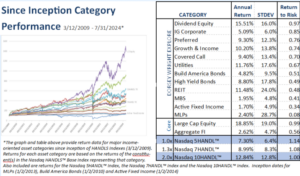
A rebound in technology stocks drove the Core Large Cap Equity category to a 1.6% gain in August. Meanwhile, the Core Fixed Income category gained 1.5% as bond prices benefitted from lower yields.

For the Nasdaq Dorsey Wright Explore portion of HANDLS Indexes, interest-rate-sensitive categories remained the big beneficiaries of declining interest rates. REITS and Utilities saw gains of 5.6% and 4.8%, respectively, for August. After a disastrous 2023 that saw significant losses, Utilities are now the top-performing category on a year-to-date basis with a return of 22.1%. As in July, MLPs were once again the worst performer, gaining 0.5% in August, but remain up 18.3% for the year.

HANDLS indexes delivered positive returns across the board in August:

  • Nasdaq 5HANDL™ Index: 2.1%
  • Nasdaq 7HANDL™ Index: 2.6% (1.3x leveraged)
  • Nasdaq 10HANDL™ Index: 3.8% (2.0x leveraged)

Disclosure: Nasdaq® is a registered trademark of Nasdaq, Inc. The information contained above is provided for informational and educational purposes only, and nothing contained herein should be construed as investment advice, either on behalf of a particular security or an overall investment strategy. Neither Nasdaq, Inc. nor any of its affiliates makes any recommendation to buy or sell any security or any representation about the financial condition of any company. Statements regarding Nasdaq-listed companies or Nasdaq proprietary indexes are not guarantees of future performance. Actual results may differ materially from those expressed or implied. Past performance is not indicative of future results. Investors should undertake their own due diligence and carefully evaluate companies before investing. ADVICE FROM A SECURITIES PROFESSIONAL IS STRONGLY ADVISED. © 2024. Nasdaq, Inc. All Rights Reserved

Important Disclosure. HANDLS Indexes receives compensation in connection with licensing its indices to third parties. Any returns or performance provided within are for illustrative purposes only and do not demonstrate actual performance. Past performance is not a guarantee of future investment results. It is not possible to invest directly in an index. Exposure to an asset class is available through investable instruments based on an index. HANDLS Indexes does not sponsor, endorse, sell, promote or manage any investment fund or other vehicle that is offered by third parties and that seeks to provide an investment return based on the returns of any index.  There is no assurance that investment products based on an index will accurately track index performance or provide positive investment returns. HANDLS Indexes is not an investment advisor, and HANDLS Indexes makes no representation regarding the advisability of investing in any such investment fund or other vehicle. A decision to invest in any such investment fund or other vehicle should not be made in reliance on any of the statements set forth in this document. Prospective investors are advised to make an investment in any such fund or other vehicle only after carefully considering the risks associated with investing in such funds, as detailed in an offering memorandum or similar document that is prepared by or on behalf of the issuer of the investment fund or other vehicle. Inclusion of a security within an index is not a recommendation by Indexes to buy, sell, or hold such security, nor is it considered to be investment advice. The information contained herein is intended for personal use only and should not be relied upon as the basis for the execution of a security trade. Investors are advised to consult with their broker or other financial representative to verify pricing information for any securities referenced herein. Neither Indexes nor any of its direct or indirect third-party data suppliers or their affiliates shall have any liability for the accuracy or completeness of the information contained herein, nor for any lost profits, indirect, special or consequential damages. Either Indexes or its direct or indirect third-party data suppliers or their affiliates have exclusive proprietary rights in any information contained herein. The information contained herein may not be used for any unauthorized purpose or redistributed without prior written approval from HANDLS Indexes. Copyright © 2024 by HANDLS Indexes. All rights reserved.

Catalyst Funds and Perini Capital LLC Launch the Catalyst Strategic Income Opportunities Fund

Partnership Marks the Third New Sub-Advisor Relationship for Catalyst in 2024 as Firm Launches First Closed-End, Interval Fund

New York, NY (September 5, 2024) – Catalyst Funds, a provider of alternative investment solutions, and Perini Capital, a fixed income and structured credit- focused alternative asset manager, announced the launch of the Catalyst Strategic Income Opportunities Fund (CSIOX). The Fund, which began trading on August 5, invests primarily in domestic asset-backed fixed income securities and is the first closed-end offering from Catalyst.

Catalyst is an investment manager whose mission is to help investors achieve their financial goals through distinctive strategies for dynamic market environments. Catalyst seeks to be the market leader in providing strategies with a decidedly different approach to educating, informing, and potentially solving challenges faced by investors. Catalyst is committed to excellence with a culture centered on innovation, teamwork, and an entrepreneurial spirit that encourages a client-service mindset focused on positive outcomes.

“I am very excited about our partnership with the team at Perini Capital and the continued growth of our product lineup for our clients,” said David Miller, Chief Investment Officer and Co-Founder of Catalyst Funds. “While we have previously only offered open-end funds, this new structure provides many potential benefits. I’m proud of our team and excited to see this expansion.”

CSIOX trades a portfolio that includes agency, non-agency, and commercial mortgage-backed securities, as well as collateralized mortgage obligations, stripped mortgage-backed securities, and securities backed by automobiles, aircraft, credit card receivables, and businesses. The Fund is an interval fund that offers to make quarterly re-purchases of shares at the NAV.

“We believe that launching CSIOX in partnership with the team at Catalyst is a great opportunity to deliver investment solutions to clients in a fund structure that fits the nature and duration of our target asset mix,” said Michael Perini, CEO of Perini Capital.

CSIOX will be sub-advised by Perini Capital LLC. The Fund’s objective is to seek total return. For more information on this Fund and Catalyst’s offerings, please visit: www.catalystmf.com.

For media inquiries on this announcement, please contact Deborah Kostroun of Zito Partners at 201-403-8185.

About Catalyst Funds

Catalyst Funds currently offers 20 distinctive funds that provide various strategies with the goal of producing income- and equity-oriented returns, while seeking to manage risk and volatility. Catalyst offers these exclusive strategies through a team of in-house portfolio managers and boutique institutional investment management partners. The firm strives to provide innovative strategies to support financial advisors and their clients in meeting the investment challenges of an ever-changing global market environment. For more information on Catalyst Funds and its various offerings, please visit: www.catalystmf.com.

About Perini Capital

Perini Capital, LLC is an alternative investment manager focused on investing in a broad range of structured credit and fixed income securities. Perini Capital was founded in 2011. The firm’s primary office is located in Scottsdale, Arizona. More information is available at www.perinicapital.com.

Investors should consider the investment objectives, risks, and charges and expenses of the Fund(s) before investing.  The prospectus contains this and other information about the Fund(s) and should be read carefully before investing.  The prospectus may be obtained at CatalystMF.com

Risk Considerations

Investing in the Fund carries certain risks. The value of the Fund may decrease in response to the activities and financial prospects of an individual security in the Fund’s portfolio. Investors in the Fund bear the risk that the Fund may not be successful in implementing its investment strategies. When the Fund invests in asset-backed securities and mortgage-backed securities, the Fund is subject to the risk that, if the underlying borrowers fail to pay interest or repay principal, the assets backing these securities may not be sufficient to support payments on the securities. Interest rate risk is the risk that bond prices overall, including the prices of securities held by the Fund, will decline over short or even long periods of time due to rising interest rates. Bonds with longer maturities tend to be more sensitive to interest rates than bonds with shorter maturities. Lower-quality bonds, known as “high yield” or “junk” bonds, present greater risk than bonds of higher quality, including an increased risk of default. Credit risk is the risk that the issuer of a security will not be able to make principal and interest payments when due. These factors may affect the value of your investment.

Shares of the Fund are not listed on any securities exchange, which makes them inherently illiquid. There is no secondary market for the Fund’s shares, and it is not anticipated that a secondary market will develop. As a result of the foregoing, an investment in the Fund’s shares is not suitable for investors who cannot tolerate risk of loss or who require liquidity, other than liquidity provided through the Fund’s repurchase policy.

Although the Fund offers to repurchase at least 5% of outstanding shares on a quarterly basis in accordance with the Fund’s repurchase policy, the Fund is not required to repurchase shares at a shareholder’s option nor are shares exchangeable for units, interests or shares of any security. Moreover, the Fund is not required to extend, and shareholders should not expect the Fund’s Board of Trustees to authorize, repurchase offers in excess of 5% of outstanding shares.

The Catalyst Funds are distributed by Foreside Fund Services, LLC.